
PluriActiv vs. Other Supplements:
What Makes It Different?
\
* Dokudami PluriActiv is Illumera Life's exclusive version of Dr. Aswin Wattanapramote's Dokudami botanical formulation. Throughout this guide, we'll refer to it simply as PluriActiv for readability while explaining the ingredients, fermentation process, and formulation philosophy.
There are thousands of dietary supplements available today. So what should you actually look at when comparing one supplement with another?
Why Compare PluriActiv With Other Supplements?
When you're comparing dietary supplements, it's easy to look at the front of the bottle and assume that two products are basically the same. They may both mention the same plant, herb, or ingredient — but that doesn't necessarily mean the finished products are equivalent.
There can be significant differences in where an ingredient comes from, how it is processed, whether it is extracted or fermented, how the finished formulation is standardized, and how it is manufactured.
Even the amount taken can be different from one product to another. In other words, the name of an ingredient is only one part of the comparison.
That's one reason I think it's useful to look beyond the label and understand what actually goes into making a supplement.
 Same Plant ≠ Same Supplement
Two products can contain the same plant and still be very different supplements.
The source of the plant, the way it is processed, the compounds that remain in the finished material, the use of fermentation or extraction, the formulation, and the manufacturing process can all influence what ultimately ends up in the capsule.
In other words ... the name of an ingredient is only one part of the comparison
When comparing PluriActiv with another supplement, those are some of the things worth looking at. Rather than simply asking, "Does this product contain Houttuynia cordata?" a more useful question is:
"How is that ingredient prepared, processed, and formulated?"
Start With the Source: Houttuynia cordata
If you're comparing plant-based supplements, a good place to start is with the plant itself.
PluriActiv begins with Houttuynia cordata, a botanical commonly known in parts of Asia as Dokudami or Fish Mint. But simply seeing Houttuynia cordata on two supplement labels doesn't tell you everything you need to know about the finished products.
The plant is only the starting point. What happens to it afterward — how it is prepared, processed, fermented, standardized, and formulated — can create meaningful differences between products.
That's why I think a better comparison goes beyond simply asking, "Does this contain Houttuynia?"
When Comparing Plant-Based Supplements, Ask:
Lorem ipsum dolor sit amet, dolore consectetur adipisicing elit, sed duius eiusmod tempor incididunt ut labore labore magna aliqua.
What plant is actually being used?
Look for the botanical name rather than relying only on a common name or marketing name.
Which part of the plant is used?
Leaves, stems, roots, flowers, or the whole plant can result in different starting materials.
How is the plant processed?
Drying, extraction, grinding, concentration, and other processing methods can produce different finished ingredients.
Is it fermented?
If fermentation is part of the formulation, it's worth understanding what kind of process is used and why.
Is it standardized?
It's useful to understand how consistency is defined and maintained. Not every supplement is standardized in the same way.
Is there information about manufacturing?
A supplement comparison shouldn't stop with ingredient list. Manufacturing practices can tell you more about the finished product.
These questions don't automatically tell you which supplement is right for a particular person. They simply give you a better way to understand what you're actually comparing.
And with PluriActiv, one of the biggest differences to look at is what happens to the Houttuynia cordata after the plant is sourced — including the proprietary fermentation process used in its production.
Fermented vs. Non-Fermented Plant Supplements
One of the most important differences to look for when comparing plant-based supplements is how the plant is processed.
Some supplements use a plant in a relatively straightforward form — for example, dried, powdered, or extracted material. Others use additional processing steps designed to change the characteristics of the plant material before it becomes part of the finished supplement.
Fermentation is one of those processes.
In PluriActiv, Houttuynia cordata undergoes a proprietary fermentation process before becoming the finished supplement. The purpose isn't simply to ferment the plant or make it more acidic. The process is designed to use microorganisms to help transform components of the plant material in a controlled way.
What Does Fermentation Actually Do?
In simple terms, fermentation uses microorganisms to interact with the plant material and transform some of its components.
Depending on the plant and the fermentation process, this can change the chemical and biological characteristics of the resulting material. That's one reason a fermented botanical preparation shouldn't automatically be considered identical to the same plant that has simply been dried or powdered.
With PluriActiv, the specific microorganisms used in the fermentation process are proprietary and are not publicly disclosed. What can be said is that the process uses food-grade, safety-validated microorganisms selected for their role in biotransformation, rather than simply for producing acidity.
The goal is a controlled and repeatable fermentation process that produces a consistent finished ingredient.
Why Fermentation Is Part of the PluriActiv Process
PluriActiv isn't simply Houttuynia cordata placed into a capsule. Fermentation is part of the way the botanical ingredient is prepared.
This distinction matters when comparing supplements because two products can start with the same plant but use very different processing methods.
Research on fermented botanicals also provides a reason to investigate whether fermentation can alter the availability or characteristics of compounds found in a plant. However, research involving fermented or non-fermented Houttuynia preparations should not automatically be interpreted as evidence for the specific PluriActiv formulation.
In other words, the existence of research on Houttuynia or fermented plant preparations is not the same thing as a clinical head-to-head comparison of PluriActiv with another supplement.
How Is the Fermentation Process Controlled?
Another important question is consistency.
Fermentation is a biological process, so simply saying that an ingredient is "fermented" doesn't tell you very much about how the process is controlled.
The PluriActiv process uses standardization together with biological performance markers to help monitor the fermentation and maintain consistency in the finished material. That approach is different from relying on a single chemical compound as the only measure of what the fermented botanical contains.
This is an important distinction because a complex botanical preparation contains many naturally occurring components. Looking at the overall characteristics of the finished material can provide a broader picture than focusing on one isolated compound alone.
NON-FERMENTED BOTANICAL
FERMENTED BOTANICAL
So when comparing PluriActiv with another Houttuynia cordata supplement, the question isn't simply whether both products contain the same plant. It's also worth asking what happened to that plant before it became the finished ingredient.
And fermentation is only one part of the comparison. Another question is what happens to the plant's naturally occurring compounds during processing — and how those compounds are represented in the finished formulation.
One Plant Can Contain Many Compounds
When you see the name of a plant on a supplement label, it's easy to think of that plant as a single ingredient. In reality, plants are complex biological materials containing many naturally occurring compounds.
Houttuynia cordata is no exception.
Among the compounds that have been identified in Houttuynia are quercetin, quercitrin, rutin, and kaempferol. These belong to a larger group of naturally occurring plant compounds called flavonoids.
The important point for a supplement comparison isn't that these compounds have impressive-sounding names. It's that the plant's chemical profile is more complicated than a single isolated ingredient.
Looking Beyond a Single Compound
This becomes particularly relevant when comparing different botanical preparations.
One product might focus on a particular extracted compound. Another might use a broader plant extract. Another may use the plant in a fermented preparation. Even when the original plant is the same, the resulting ingredients can have different chemical profiles.
That's why it can be misleading to compare supplements simply by looking for one familiar compound on the label.
A more useful question is:
What does the finished preparation actually contain, and how did it get there?
The Role of Processing
Processing can matter because the material that starts with the plant isn't necessarily identical to the material that ends up in the finished supplement.
Drying, grinding, extraction, concentration, and fermentation are all different approaches to preparing botanical ingredients. Each can affect the characteristics of the resulting material.
In the case of PluriActiv, fermentation is part of that process. Rather than treating Houttuynia cordata as though it were simply one isolated compound, the formulation begins with the plant as a complex botanical and uses a controlled fermentation process as part of its preparation.
Houttuynia cordata
Naturally occurring plant compounds
Quercetin • Quercitrin • Rutin • Kaempferol
Processing / Fermentation
Finished PluriActiv formulation

A complex botanical is more than a single compound.
This doesn't mean that every compound in a plant has the same role, or that having more compounds automatically makes one supplement better than another. It simply means that the composition and processing of a botanical are worth considering when making a comparison.
And that brings us to another important part of the equation: the difference between the raw botanical ingredient and the finished formulation.
The Ingredient Is Only Part of the Story
Imagine picking up two supplement bottles and seeing Houttuynia cordata listed on both labels.
At first glance, it might seem like you're comparing two versions of essentially the same ingredient. But the name of the plant doesn't tell you everything about what is actually inside the capsule.
The starting plant is only the beginning. Different manufacturers can use different sources, processing methods, extraction techniques, fermentation processes, concentrations, and formulations.
So two products can start with the same plant and still end up with very different finished ingredients.
From Plant to Finished Ingredient
There is a journey between a plant growing in the ground and a finished supplement sitting in a bottle.
Along the way, a manufacturer may make decisions about how the plant is harvested, prepared, dried, extracted, fermented, concentrated, standardized, and ultimately formulated.
Each of those steps can affect the characteristics of the material that eventually goes into the finished product.
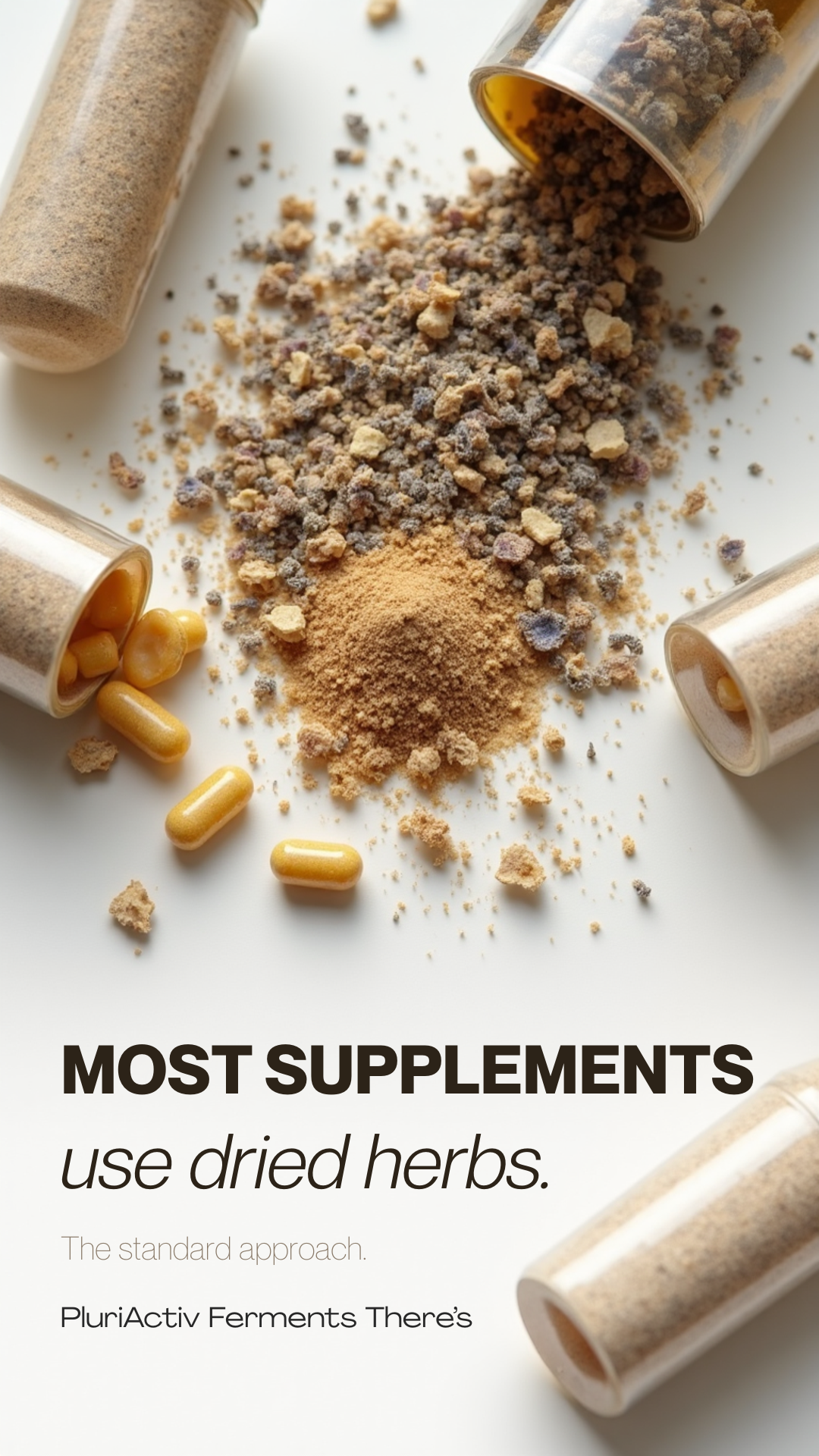

The label tells you the starting point. The manufacturing process tells you much more about the journey.
Why "Houttuynia cordata" Doesn't Tell You Everything
This is why simply comparing the words on the ingredient list can sometimes oversimplify the comparison.
One Houttuynia product might be a straightforward dried botanical powder. Another might be an extract. Another might undergo fermentation before being incorporated into the finished formulation.
Those aren't necessarily interchangeable preparations just because they share the same botanical name.
And the differences don't stop with the plant itself. The amount used, the form of the finished product, the manufacturing environment, and the quality-control practices can all be part of the picture.
What About PluriActiv?
PluriActiv starts with Houttuynia cordata and then follows a specific production process that includes proprietary fermentation.
The fermentation process is part of what distinguishes the finished PluriActiv ingredient from simply using dried or powdered Houttuynia. The process is controlled and standardized, with the finished material evaluated using biological performance markers as part of the quality approach.
In other words, PluriActiv isn't defined only by the plant it starts with, but also by what happens to that plant along the way.
When comparing two botanical supplements, don't stop at the ingredient name.
Ask how the ingredient was sourced, processed, fermented or extracted, standardized, and ultimately formulated.
So Where Does PluriActiv Fit?
By this point, you can see why comparing botanical supplements isn't always as simple as comparing ingredient lists.
PluriActiv starts with Houttuynia cordata, but the finished supplement is defined by more than the name of the plant. Its production involves a proprietary fermentation process, controlled processing, standardization, and a finished formulation designed around the resulting botanical material.
So when you're comparing PluriActiv with another supplement, these are some of the characteristics worth looking at.
A Closer Look at the Comparison
What to Compare | What to Look For With Any Supplement | PluriActiv |
|---|---|---|
Plant Source | What botanical is being used, and where does it come from? | Houttuynia cordata (Dokudami / Fish Mint) |
Processing | How is the plant prepared before becoming the finished ingredient? | Controlled processing that includes proprietary fermentation |
Fermentation | Is fermentation used? If so, what is its purpose and how is it controlled? | Proprietary fermentation using food-grade, safety-validated microorganisms |
Naturally occurring compounds | What compounds are present in the botanical preparation? | Includes naturally occurring compounds such as quercetin, quercitrin, rutin, and kaempferol |
Standardization | How is consistency monitored from one production batch to another? | Standardization combined with biological performance markers |
Quality & manufacturing | What manufacturing practices and quality standards are documented? | Manufactured under documented quality and manufacturing standards |
Finished formulation | How is the processed botanical ultimately delivered to the consumer? | Finished as the Dokudami PluriActiv dietary supplement |
The comparison above describes characteristics of the PluriActiv formulation and production process. Other supplements may use different ingredients, processing methods, or manufacturing approaches.
What Makes the PluriActiv Approach Different?
Instead of comparing supplements only by the name of an ingredient or the number of ingredients on a label, consider the entire path from plant to finished product:
Where did it come from? → How was it processed? → Was it fermented or extracted? → How was consistency maintained? → How was it formulated? → How was the finished product manufactured?
That broader view can tell you considerably more than an ingredient name by itself.
That's the approach behind PluriActiv.
It starts with Houttuynia cordata, incorporates a proprietary fermentation process, and carries that processed botanical through to a standardized finished formulation.
If you'd like to explore any of those pieces in more detail, you can take a closer look at [PluriActiv Ingredients], [PluriActiv Science], or [What Is PluriActiv?].
What This Comparison Does — and Doesn't — Tell You
Comparing supplements can help you understand how different products are made, but it's important to understand what a comparison like this can — and can't — tell you.
Looking at the plant source, processing methods, fermentation, naturally occurring compounds, formulation, and manufacturing practices can help you understand how two products differ.
But a difference in formulation doesn't automatically mean that one product will produce better results for every person.
A Product Comparison Isn't a Clinical Trial
There's also an important distinction between comparing formulations and comparing results.
A product may have a different manufacturing process, a different concentration, or a different combination of naturally occurring compounds. Those differences can be described objectively.
But determining whether one finished supplement actually produces better outcomes than another requires appropriate research — ideally including well-designed studies that directly compare the products in question.
In other words, being different isn't the same thing as being proven better.
Individual Experience Can Vary
Even when two people use the same supplement, their experiences may not be identical. Diet, lifestyle, individual differences, consistency of use, and other factors can all play a role in how someone experiences a supplement.
That's why personal experience can be useful as part of someone's own decision-making, but it shouldn't be confused with scientific evidence demonstrating that a product will produce the same result for everyone.
The goal of this comparison is simply to help you understand what you're comparing — not to tell you what conclusion you should reach.
Different doesn't automatically mean better.
A meaningful comparison looks at the ingredients, the processing, the formulation, the manufacturing, and the available evidence — not just the claims on the front of a bottle.
Questions to Ask Before Choosing a Supplement
With so many dietary supplements available, it can be difficult to know what is actually worth comparing. A long ingredient list or an attractive label doesn't necessarily tell you how a product was made.
A few simple questions can help you look beyond the marketing and better understand what you're actually buying.
 1. What exactly is in it?
Look beyond the product name and identify the actual ingredients. If it's a botanical supplement, look for the botanical name and pay attention to the amount and form of the ingredient being used.
2. Where does the ingredient come from?
Consider the source of the botanical or other active ingredients. Is the source identified? Is the plant or ingredient clearly described? Knowing what you're starting with is the first step toward understanding the finished product.
 3. How is it processed?
Processing can make a difference in the characteristics of a finished botanical ingredient. Ask whether the material is dried, powdered, extracted, concentrated, fermented, or prepared in another way.
 4. Is there a meaningful reason for the formulation?
Different products may use different processing methods or combinations of ingredients. Look for an explanation of why a particular approach is being used rather than simply assuming that more ingredients or more processing automatically means a better product.
 5. How is quality controlled?
Look for information about manufacturing practices, quality controls, testing, standardization, and relevant certifications. A transparent company should be able to explain how it works to maintain consistency in its finished product.
 6. What does the evidence actually show?
This may be the most important question of all. Look at the type of evidence being presented and make sure it actually applies to the product you're considering. Research on an individual plant or compound isn't necessarily the same as research on a particular finished supplement.
A Better Way to Compare
You don't need to be a scientist to ask good questions about a supplement.
What is it? Where did it come from? How was it processed? Why was it formulated this way? How is quality controlled? And what does the evidence actually tell us?
Those questions can give you a much clearer picture than the front of a bottle ever can.
Continue Exploring PluriActiv
Interested in Learning More?
PluriActiv is currently available through Illumera's wellness product line.
If you'd like to learn more about the PluriActiv product, or if you're ready to become a customer, click below.
About The Author
Brett Gurney is an entrepreneur, online marketer, and lifelong student of emerging trends in wellness, technology, and business. He likes taking complex ideas and breaking them down into practical, easy-to-understand information that helps readers stay informed and make confident decisions for themselves.
Brett is a big fan of the PluriActiv product and the technology behind it. So he shares what he learns and helps others discover trends they may not have encountered otherwise.
Subscribe to our PluriActiv Newsletter to be notified of future product launches and updates.

Copyright2026 Illumera Life - Privacy Policy